Research Areas
We focus on understanding regional weather phenomena through dynamical downscaling, observational analysis, and AI/ML applications.
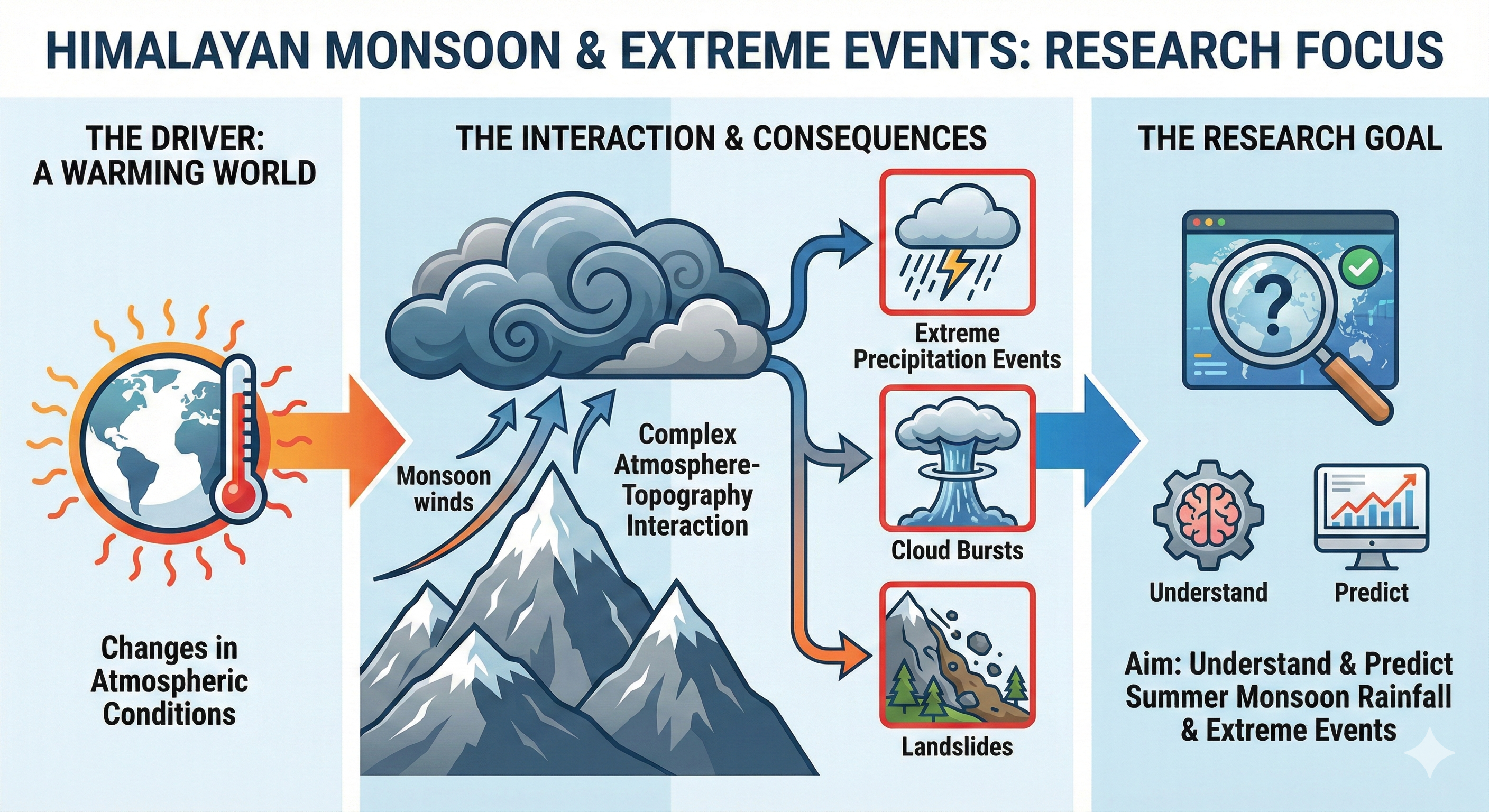
Himalayan Monsoon Rainfall
The Himalayas are a high mountain terrain with a complex interaction between atmosphere and topography. Due to a warming world, changes in atmospheric conditions cause extreme precipitation events, cloud bursts, and landslides. We aim to understand and predict the summer monsoon rainfall and extreme rainfall events over the Himalayan mountains.
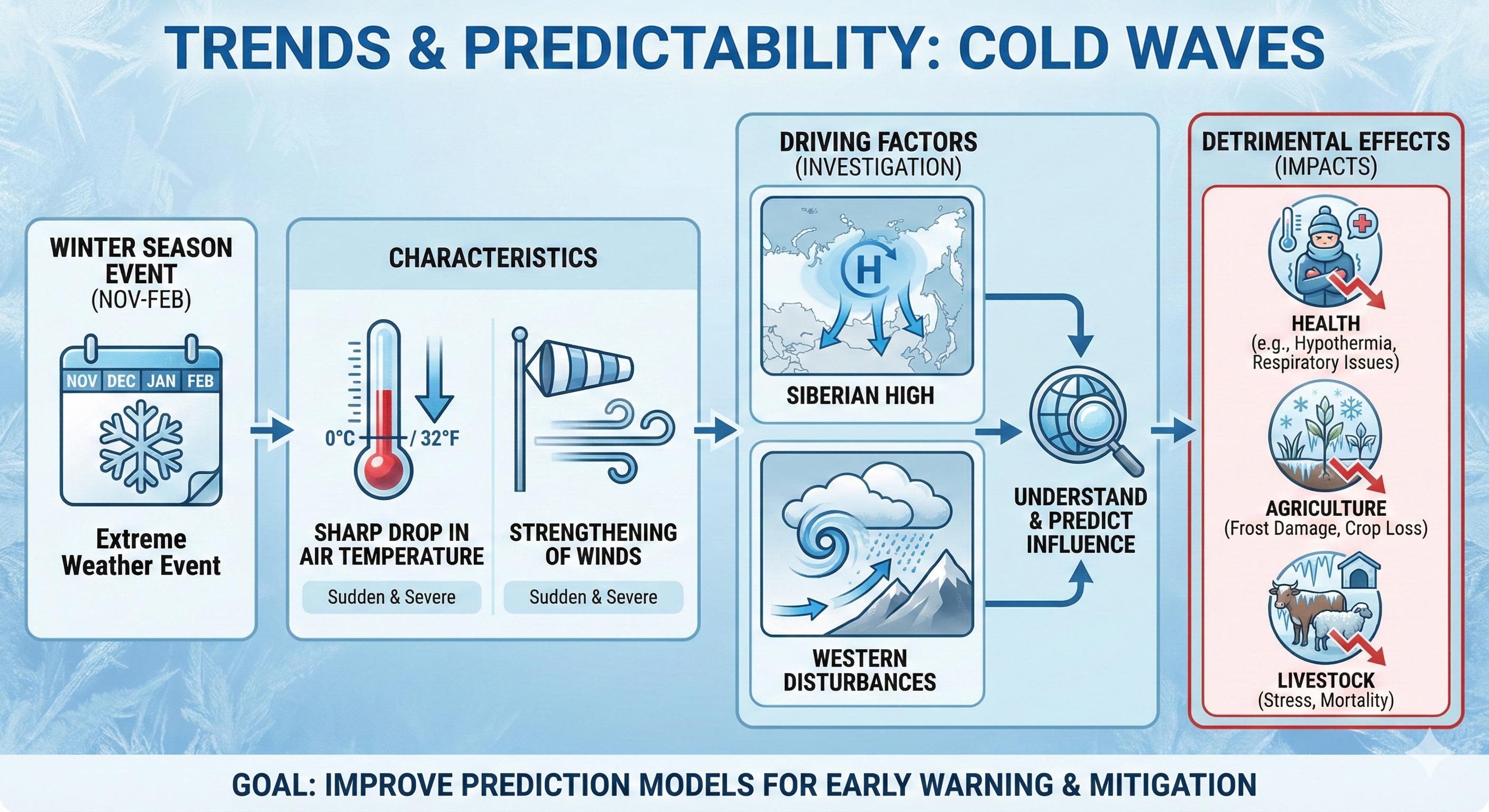
Cold Waves
Cold waves are extreme weather events prominent during the winter season (Nov-Feb). Characterized by a sharp drop of air temperature and strengthening of winds, they have detrimental effects on health, agriculture, and livestock. We investigate factors like Western Disturbances and the Siberian High to predict their influence.
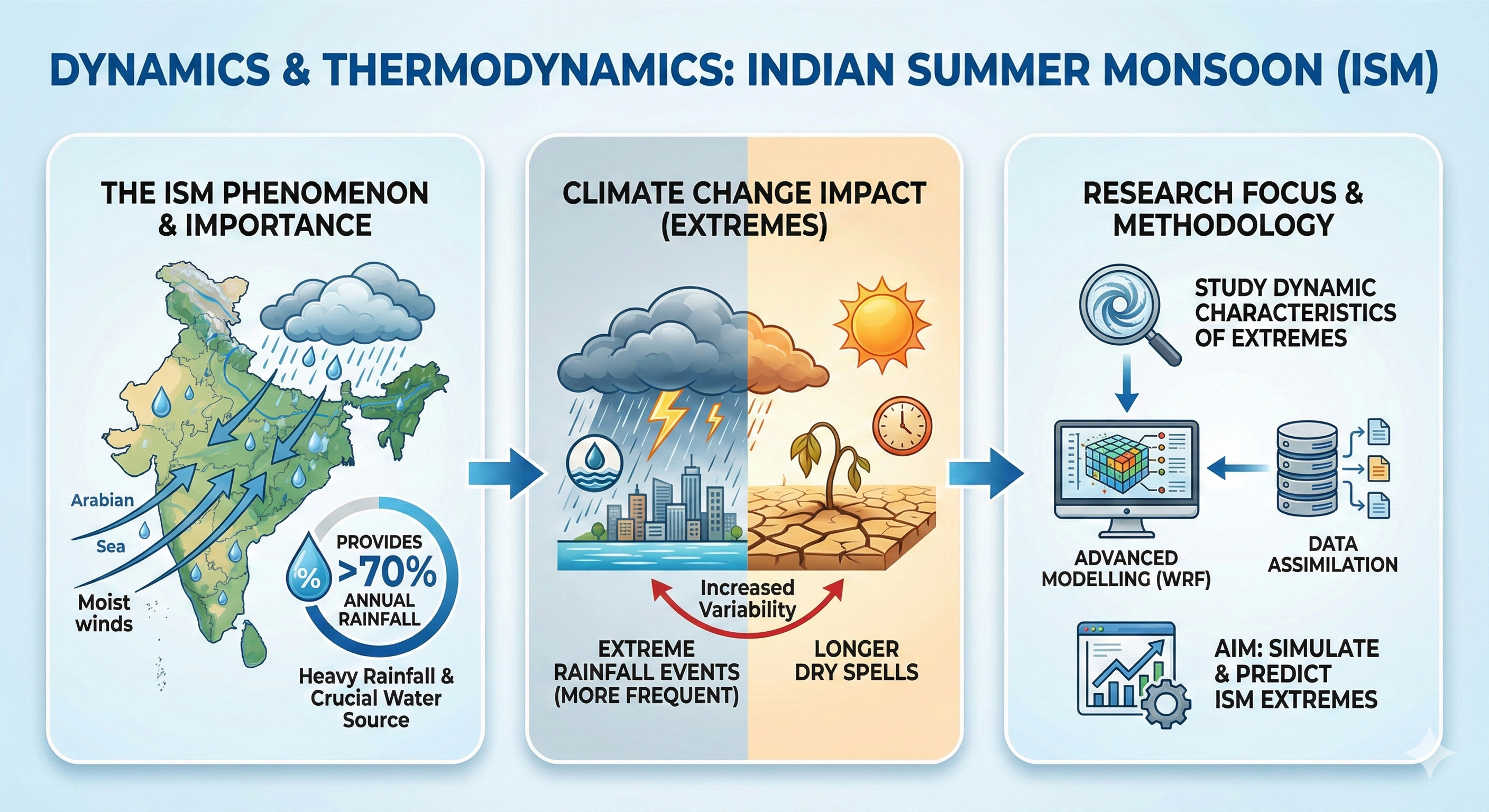
Indian Summer Monsoon
The ISM brings heavy rainfall to the subcontinent, providing over 70% of annual rainfall. Climate change is expected to lead to more extreme rainfall events and longer dry spells. We focus on studying the dynamic characteristics of ISM extremes and aim to simulate them using advanced modelling (WRF) and data assimilation.
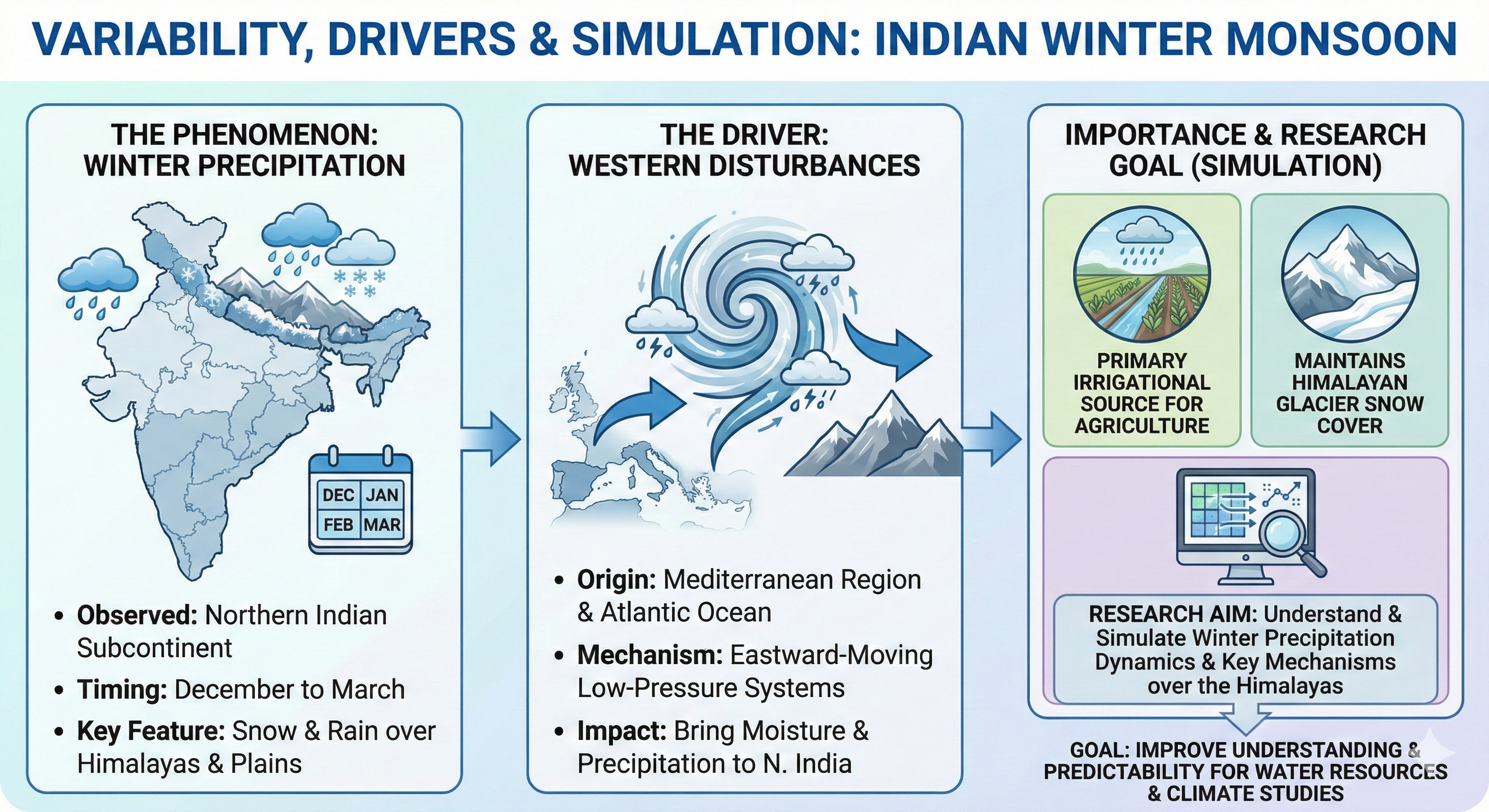
Indian Winter Monsoon
Winter precipitation is observed in the northern parts of Indian subcontinent through December to March due to the passage of western disturbances. This precipitation is a primary irrigational source for agriculture and maintains the snow cover of Himalayan glaciers. We aim to understand and simulate the winter precipitation dynamics and its key mechanisms over the Himalayas.
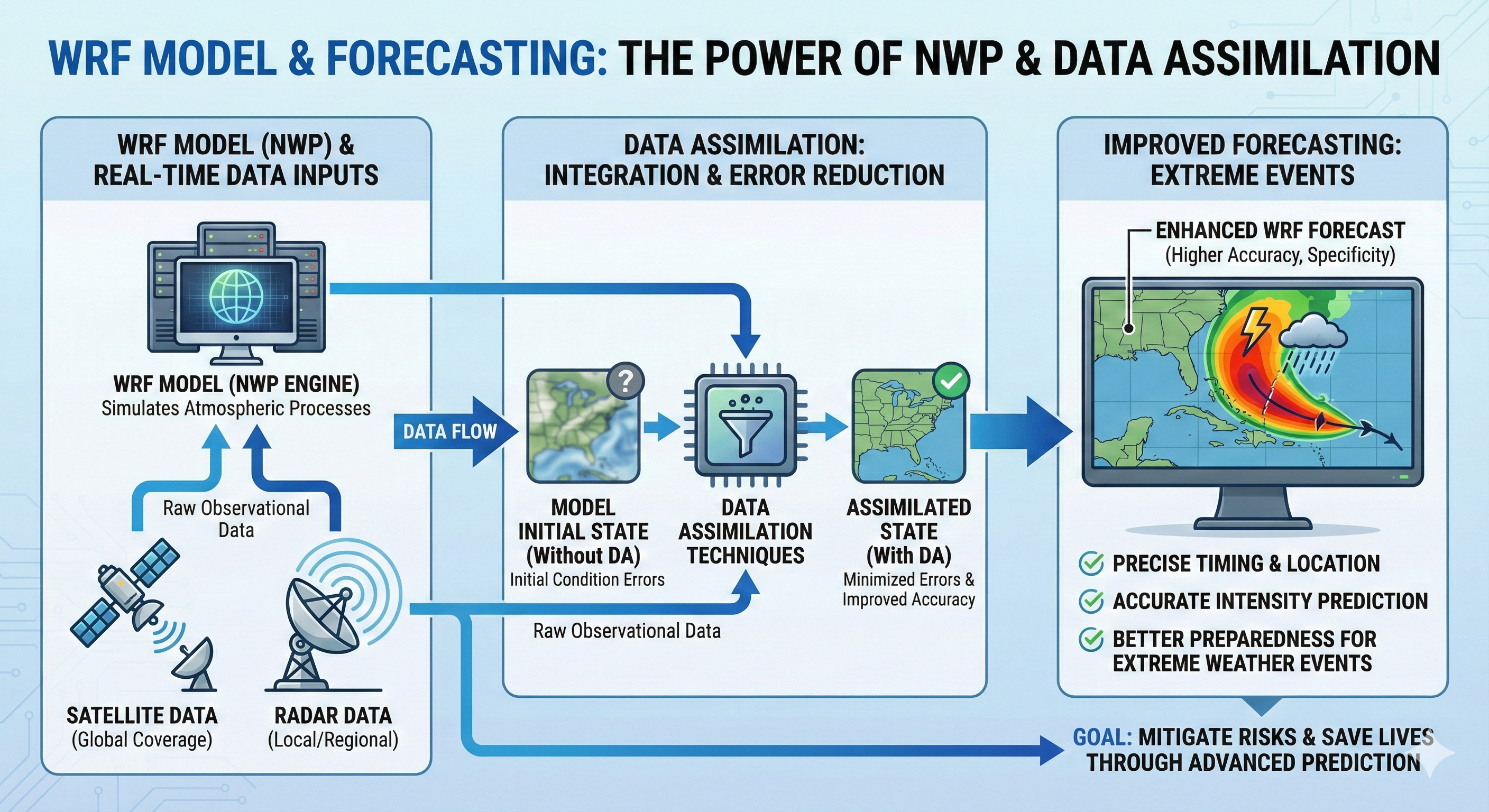
NWP and Data Assimilation
We utilize advanced Numerical Weather Prediction (NWP) models like WRF to forecast regional weather. Our research focuses on Data Assimilation techniques—integrating real-time observational data (satellite, radar) into models to minimize initial condition errors and improve the accuracy of extreme weather event predictions.
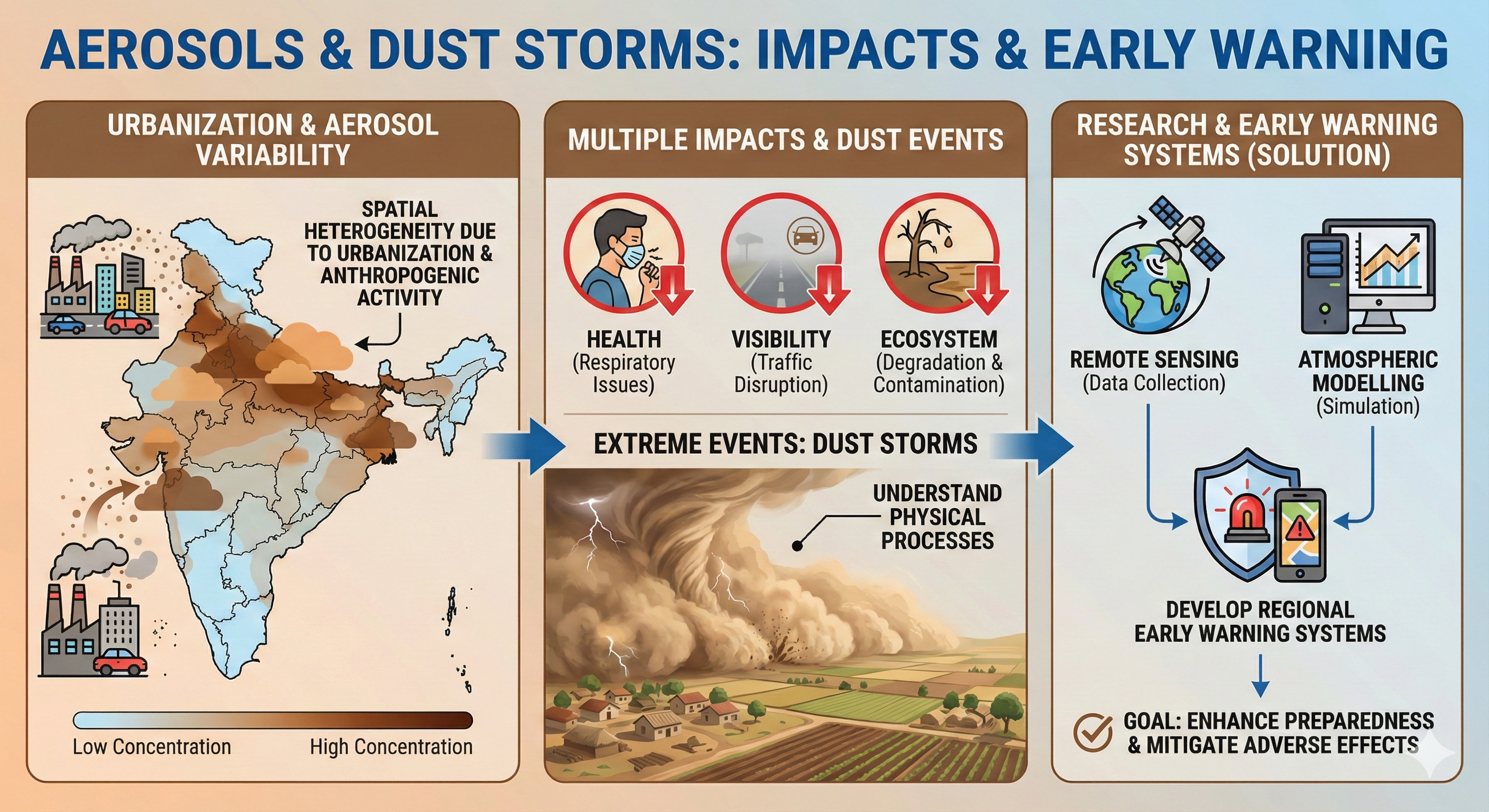
Aerosols & Dust Storms
Atmospheric aerosols demonstrate spatial heterogeneity across India due to urbanization. Abundances in aerosol concentrations impact the ecosystem, visibility, and health. Using state-of-the-art atmospheric modelling and remote sensing, we aim to understand the physical processes responsible for Dust Storms and develop regional early warning systems.
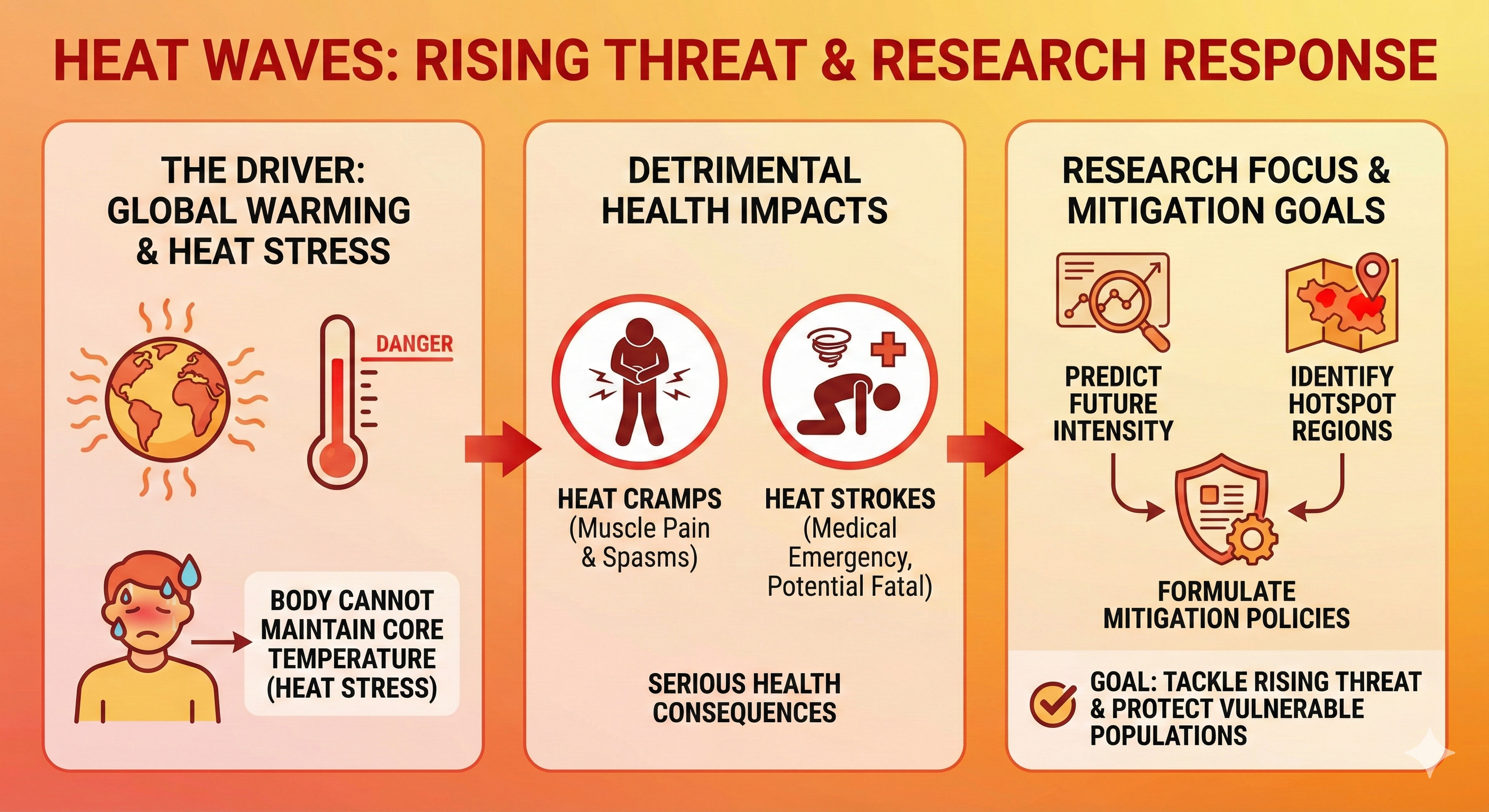
Heat Waves
Global warming is increasing heat stress, where the body cannot maintain core temperature. This has detrimental impacts such as heat cramps and strokes. We study heat stress to predict its future intensity, identify hotspot regions, and help formulate mitigation policies to tackle this rising threat.
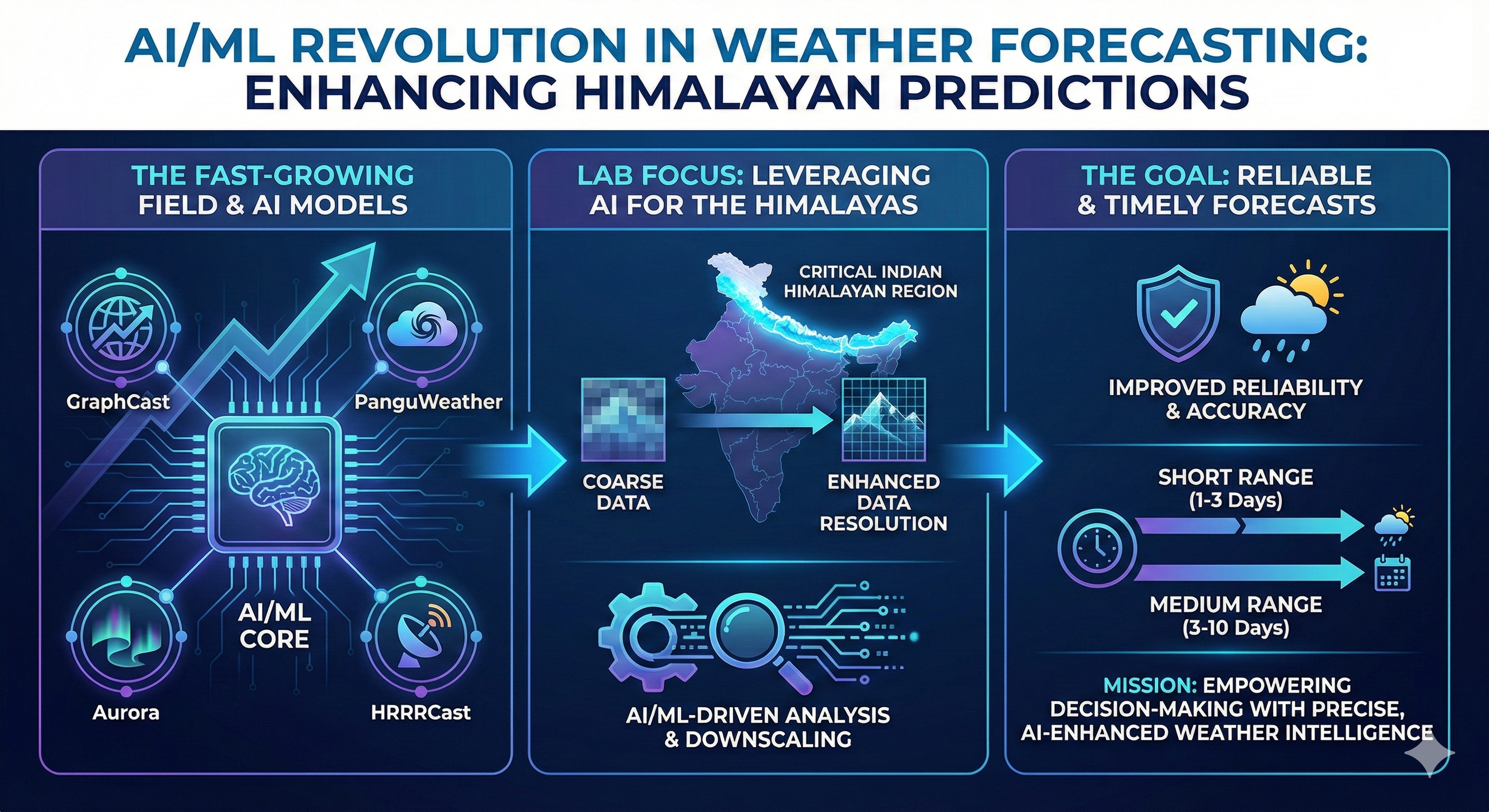
AI/ML in Climate
Machine Learning and Artificial Intelligence is one of the fastest growing fields in technology, with the advent of modules like GraphCast, PanguWeather , Aurora , HRRRCast and many more models , the area of ML driven weather analysis and forecasting has been revolutionised. Our lab focusses on levergaing AI/ML to enhance the data resolution in critical Indian Himalayan region and also to provide more reliable short and medium range forecasts.
Computational Facilities
Our lab is equipped with 9 high-performance workstations essential for running complex atmospheric simulations (WRF, ROMS) and training deep learning models.
Xeon Platinum Compute Node
High-performance node for heavy AI/ML workloads.
High-Memory Gold Server
Massive memory capacity for large-scale data assimilation.
RTX A4000 Workstation
GPU-accelerated workstation for climate rendering.
Xeon Gold Cluster Node
Dedicated node for WRF model simulations.
Xeon Silver Compute Node A
Balanced node for parallel processing tasks.
Xeon Silver Compute Node B
optimized for atmospheric data analysis.
Standard Workstation 1
General purpose node for post-processing.
Standard Workstation 2
General purpose node for visualization.
Standard Workstation 3
Optimization and coding workstation.
Unified NAS Storage System
36 Hot-swap SAS HDD bays • 100Gbps InfiniBand Low Latency